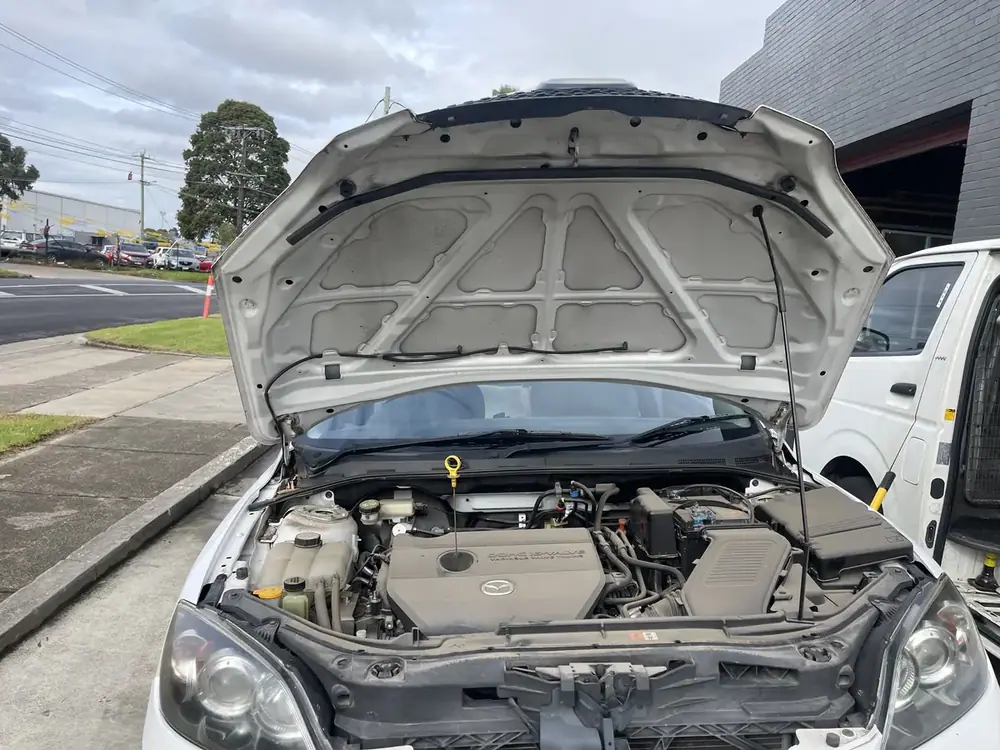
Start with the service history and your departure date
Check when the vehicle was last serviced and whether the manufacturer's time or kilometre interval is approaching. A car that has covered few kilometres can still be due for time-based maintenance. Share the service records and current odometer reading so the mechanic can discuss the appropriate scope.
Book with enough time for diagnosis, parts and any follow-up work. Mention the departure date when enquiring, but do not assume every repair can be completed immediately before a trip. Explain whether you are planning a longer highway journey, carrying extra luggage or towing.
Check tyres and the spare before loading the car
Look for visible cuts, bulges or uneven wear and have damage assessed before travelling. Check pressures when the tyres are cold, using the vehicle placard or owner's manual rather than the maximum pressure printed on the tyre. Follow the vehicle's instructions for the intended load.
If the car has a spare, check its condition and pressure too. If it uses a repair kit, locate it and check the sealant expiry and instructions. A kit is not suitable for every type of damage. Knowing what equipment you have avoids discovering a missing item after a puncture.
Do not leave brake concerns until the journey
Tell the mechanic about grinding, vibration while braking, pulling to one side, warning lights or a change in pedal feel. These symptoms need assessment; they do not establish which part has failed.
Ask whether the brakes need a specific inspection in addition to the planned service. If braking feels unsafe, do not drive the vehicle to test it yourself. Arrange an assessment where it is parked or suitable recovery.
Report fluid loss rather than repeatedly topping up
With the engine cold and the vehicle parked safely, check accessible fluid levels as described in the owner's manual. Use only the specified products. Never remove a cooling-system cap while the engine is hot.
Repeated coolant loss, oil patches, a rising temperature gauge or an unfamiliar smell should be investigated before a long drive. Let the mechanic know when the symptom occurs and whether fluid has been added recently. A top-up does not establish why the level fell.
Mention slow starts and check visibility equipment
A slow start or repeated need for a jump-start deserves testing before you rely on the car away from home. Battery condition, connections and charging performance can be relevant; replacing a battery without identifying the cause may leave the problem unresolved.
Check the lights, indicators, washers and wipers. Clean the glass and replace damaged wiper blades as needed. Carry your roadside-assistance contact details and a charged phone. Plan rest stops as well as vehicle preparation.
Arrange a suitable mobile-service location
For a St Kilda, Elwood or Balaclava visit, provide a safe, firm and level parking area with room around the car. For shared or apartment parking, confirm permission and send entry, clearance and access details before booking.
Ask what the agreed visit covers and what cannot be assessed at the location. Some concerns require additional testing or workshop access. A & A can discuss servicing and diagnostic needs, explain findings and seek approval for further work where required.
- Vehicle make, model, year and current kilometres
- Last service date and available records
- Warning lights, noises, fluid loss or starting concerns
- Exact suburb and parking access
- Departure date and any towing or extra-load plans